


An enlarged male chest does not always result from excess body fat.
In many men, breast enlargement involves a combination of fatty tissue and firm glandular breast tissue. This distinction is important because the correct treatment depends on what is causing the enlargement.
I am Dr Gökhan Özerdem, Specialist in Aesthetic, Plastic and Reconstructive Surgery in Antalya, Turkey. With more than 25 years of surgical experience, I perform gynecomastia surgery for men who want to improve their chest contour.
In my practice, I frequently combine liposuction with surgical removal of glandular breast tissue.
This allows me to address both the fatty component and the firmer tissue beneath the nipple–areola complex.
However, not every patient requires the same procedure.
The objective is not simply to remove tissue. It is to create a flatter, more proportionate male chest while preserving a natural contour.
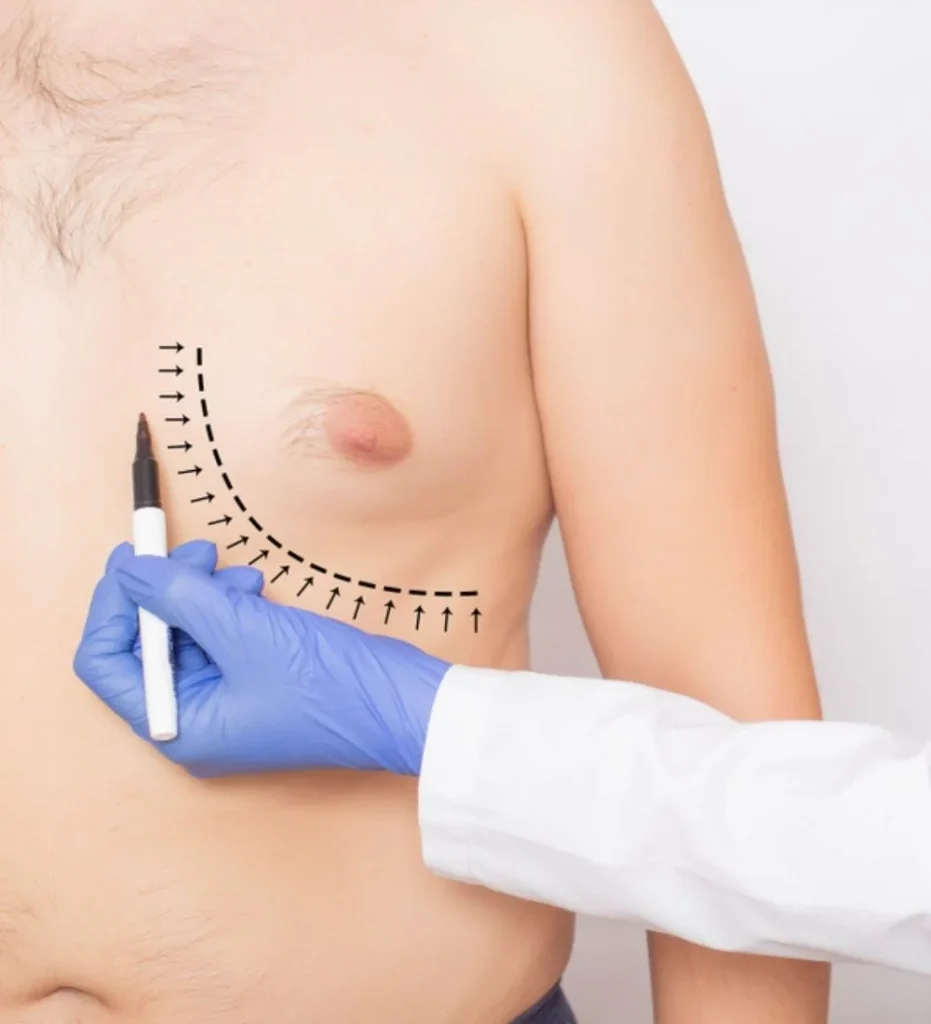
What Is Gynecomastia?
Gynecomastia is the enlargement of glandular breast tissue in males.
It may affect one or both sides of the chest.
Some men develop a relatively small enlargement directly beneath the nipple.
Others have more extensive breast enlargement involving fat, glandular tissue and stretched skin.
Gynecomastia can occur at different ages and may be associated with hormonal changes, medication, certain medical conditions or other factors.
In many cases, no single underlying cause is identified.
Before recommending surgery, I consider the patient’s medical history and the characteristics of the chest enlargement.
About Dr. Gökhan Özerdem
Specialist Plastic Surgeon in Antalya, Turkey
I am Dr Gökhan Özerdem, Specialist in Aesthetic, Plastic and Reconstructive Surgery, practising in Antalya, Turkey.
My professional background includes:
- More than 25 years of surgical experience
- Thousands of aesthetic and reconstructive surgical procedures
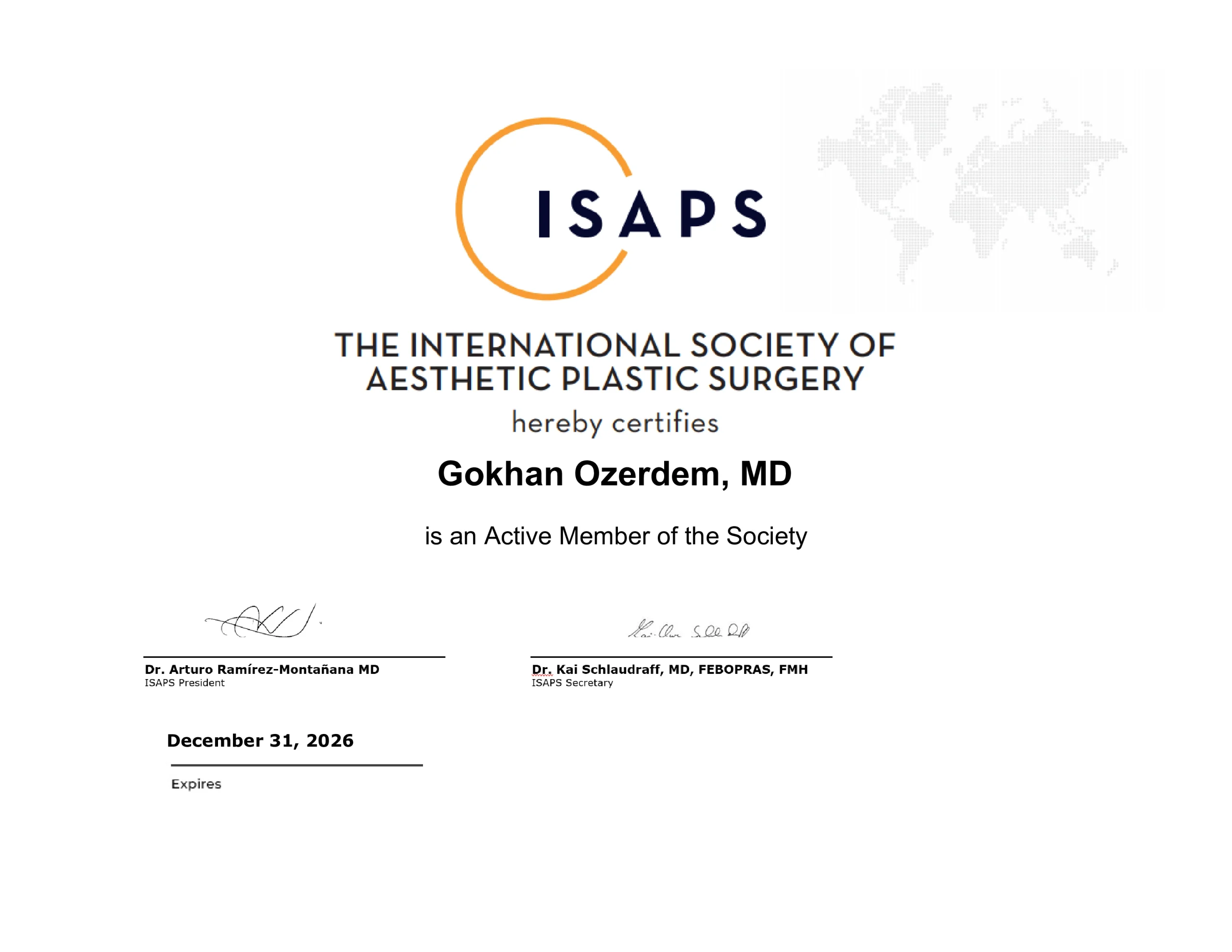
- Member of the International Society of Aesthetic Plastic Surgery (ISAPS)
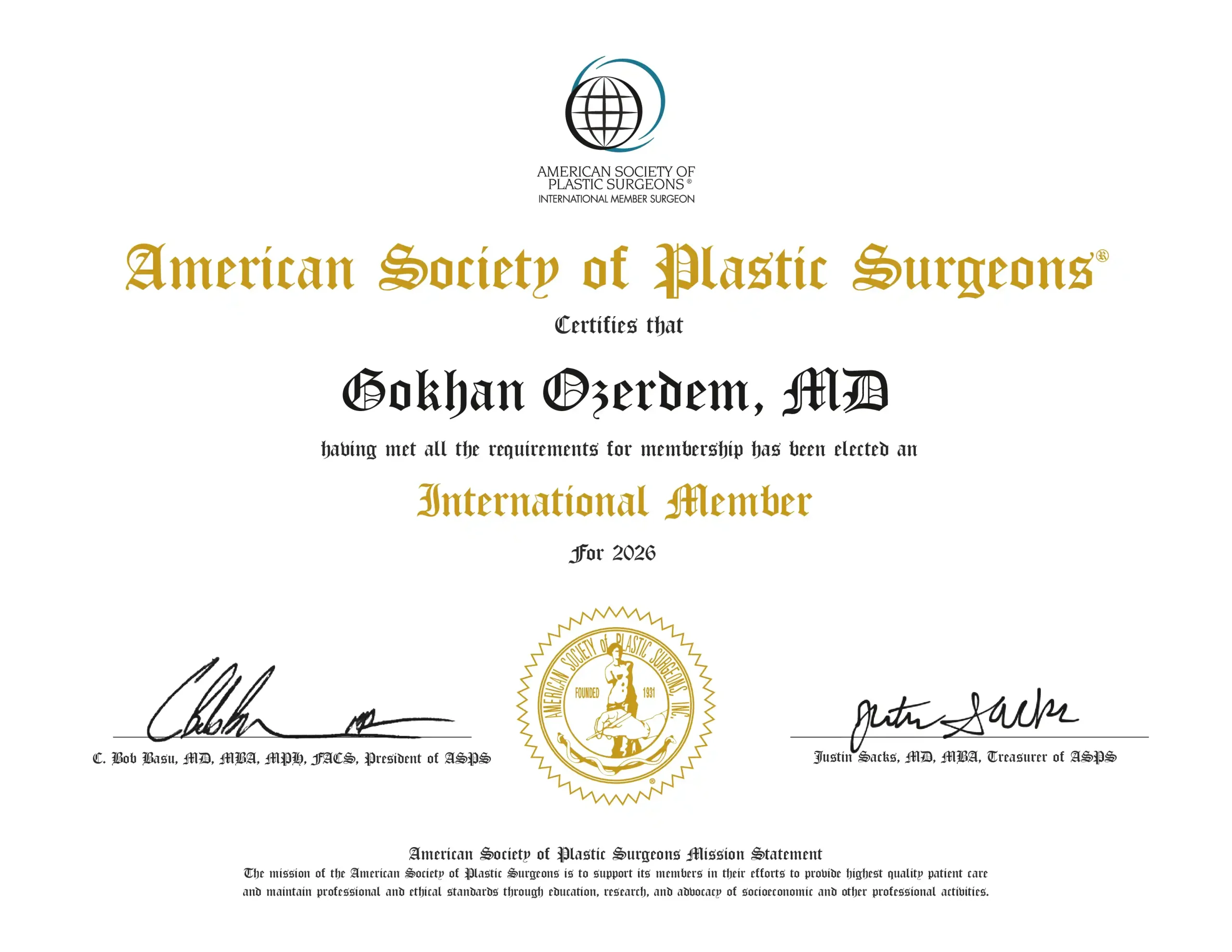
- Member of the American Society of Plastic Surgeons (ASPS)
- Member of the Turkish Society of Plastic, Reconstructive and Aesthetic Surgeons
- Member of the Turkish Society of Aesthetic Plastic Surgery
- Professional medical experience and licensing in Dubai
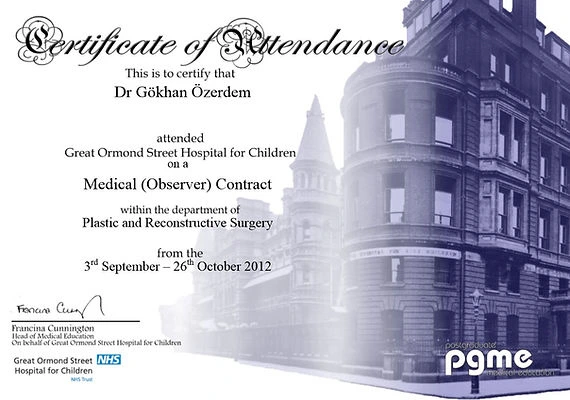
- Observer experience at Great Ormond Street Hospital for Children, London, UK
- Gamma Probe Course at Castle Hill Hospital, Hull, UK
- Oral and poster presentations at national and international scientific congresses
- Session chairmanship at the Turkish National Plastic Surgery Congress
- International scientific publications and academic work
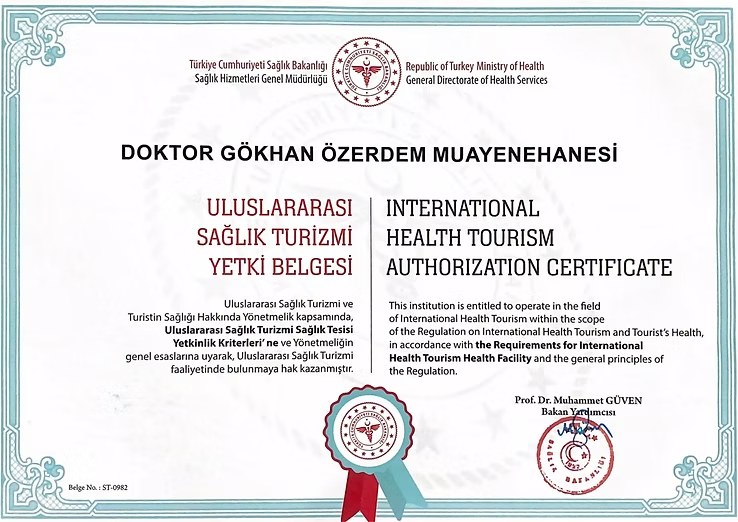
- Authorised to provide services to international patients under the relevant Turkish Ministry of Health International Health Tourism framework
Major surgical procedures are performed in fully equipped hospital facilities in Antalya with appropriate anaesthesia and medical support.

Gynecomastia or Chest Fat?
Why the Difference Matters
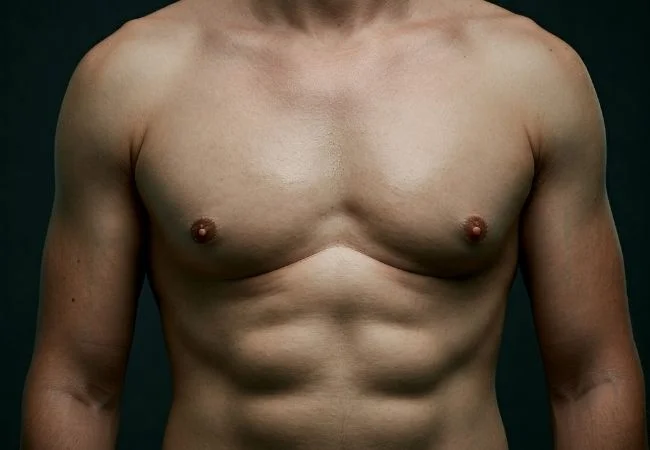
Not every enlarged male chest represents true gynecomastia.
There are two important components to consider.
Glandular Breast Tissue
True gynecomastia involves enlargement of glandular breast tissue.
This tissue is often relatively firm and may be concentrated beneath the nipple–areola complex.
It does not necessarily disappear with weight loss or exercise.
Fatty Tissue
Fat accumulation in the male chest is sometimes called pseudogynecomastia or lipomastia.
This enlargement is predominantly caused by fatty tissue rather than increased glandular tissue.
Some patients have both components.
For this reason, I do not assume that liposuction alone will correct every enlarged male chest.
The treatment should address the tissue responsible for the problem.
My Approach to Gynecomastia Surgery
In many patients, I prefer a combination of:
- Liposuction
- Direct excision of glandular breast tissue
Liposuction allows me to reduce the fatty component and improve the transition between the chest and surrounding areas.
Direct glandular excision allows me to remove firm tissue that may not respond adequately to liposuction.
The combination can be particularly useful when both types of tissue contribute to the enlargement.
I also assess skin elasticity and nipple position before deciding whether additional skin removal is necessary.
My approach is based on the anatomy rather than applying the same technique to every patient.
Why Liposuction Alone May Not Be Enough
Liposuction is effective for removing selected fatty tissue.
However, dense glandular breast tissue can be difficult to remove adequately using standard liposuction alone.
If a significant glandular component remains, the patient may continue to have a prominent area beneath the nipple.
This can produce an unsatisfactory chest contour despite removal of surrounding fat.
For this reason, I frequently combine liposuction with direct glandular excision.
Removing fat without addressing significant glandular tissue may leave the main problem unresolved.
Gland Excision in Gynecomastia Surgery
When firm glandular tissue contributes to breast enlargement, I may remove it directly through a carefully positioned incision.
In many patients, the incision can be placed along part of the border of the areola.
This location helps conceal the scar within the transition between the darker areolar skin and the surrounding chest skin.
The amount of glandular tissue removed depends on the anatomy.
I also consider the thickness of the tissue remaining beneath the nipple.
Excessive removal can create a depression or an unnatural contour.
The objective is a smooth chest rather than a hollow area beneath the areola.
Your Gynecomastia Surgery Journey in Antalya
1. Preliminary Assessment
You provide medical information, photographs and details of your chest enlargement.
2. Consultation in Antalya
I examine the chest to assess glandular tissue, fatty tissue, skin elasticity, nipple position and asymmetry.
3. Surgical Planning
We discuss whether liposuction, glandular excision or skin removal is required.
We also review scars, recovery, risks and realistic expectations.
4. Surgery
Your procedure is performed in an appropriately equipped hospital under the planned anaesthesia.
5. Early Recovery
My team and I monitor your recovery during your stay in Antalya.
6. Returning Home
You return home when your early postoperative condition allows safe travel.
7. Long-Term Follow-Up
Chest contour and scars continue to change during healing.
Follow-up communication can continue after you return to your home country.
Avoiding a Crater Deformity
One of the important technical considerations in gynecomastia surgery is avoiding excessive tissue removal beneath the nipple–areola complex.
If too much tissue is removed, the nipple area may appear depressed or attached to the underlying chest.
This is sometimes called a crater deformity.
A natural result requires careful attention to the relationship between:
- The nipple–areola complex
- Remaining subcutaneous tissue
- Pectoral muscle contour
- Surrounding chest fat
- Skin elasticity
For this reason, gynecomastia surgery should not be approached simply as removing the maximum possible amount of tissue.
Can Gynecomastia Be Corrected Without Visible Scars?
Every surgical incision creates a scar.
However, in many patients with mild or moderate gynecomastia and good skin elasticity, incisions can be relatively small and discreetly positioned.
Liposuction incisions are generally small.
When glandular excision is necessary, the incision can often be positioned at the areolar border.
These scars usually become less noticeable as they mature.
However, patients with severe enlargement and significant excess skin may require longer incisions.
I do not promise scarless surgery when skin removal is necessary.
Grades of Gynecomastia
Gynecomastia varies considerably in severity.
Although several classification systems exist, patients can broadly be considered according to breast enlargement and skin excess.
Mild Gynecomastia
There is limited enlargement, often concentrated beneath the nipple–areola complex.
Skin elasticity is usually adequate.
Selected patients may require glandular excision, liposuction or a combination.
Moderate Gynecomastia
There is more noticeable chest enlargement, often involving both glandular and fatty tissue.
Liposuction combined with glandular excision may be appropriate.
The degree of skin laxity influences the surgical plan.
Severe Gynecomastia
There may be substantial breast enlargement, stretched skin and downward displacement of the nipple–areola complex.
In these cases, tissue removal alone may not provide an appropriate chest contour.
Additional skin excision and nipple repositioning may be required.
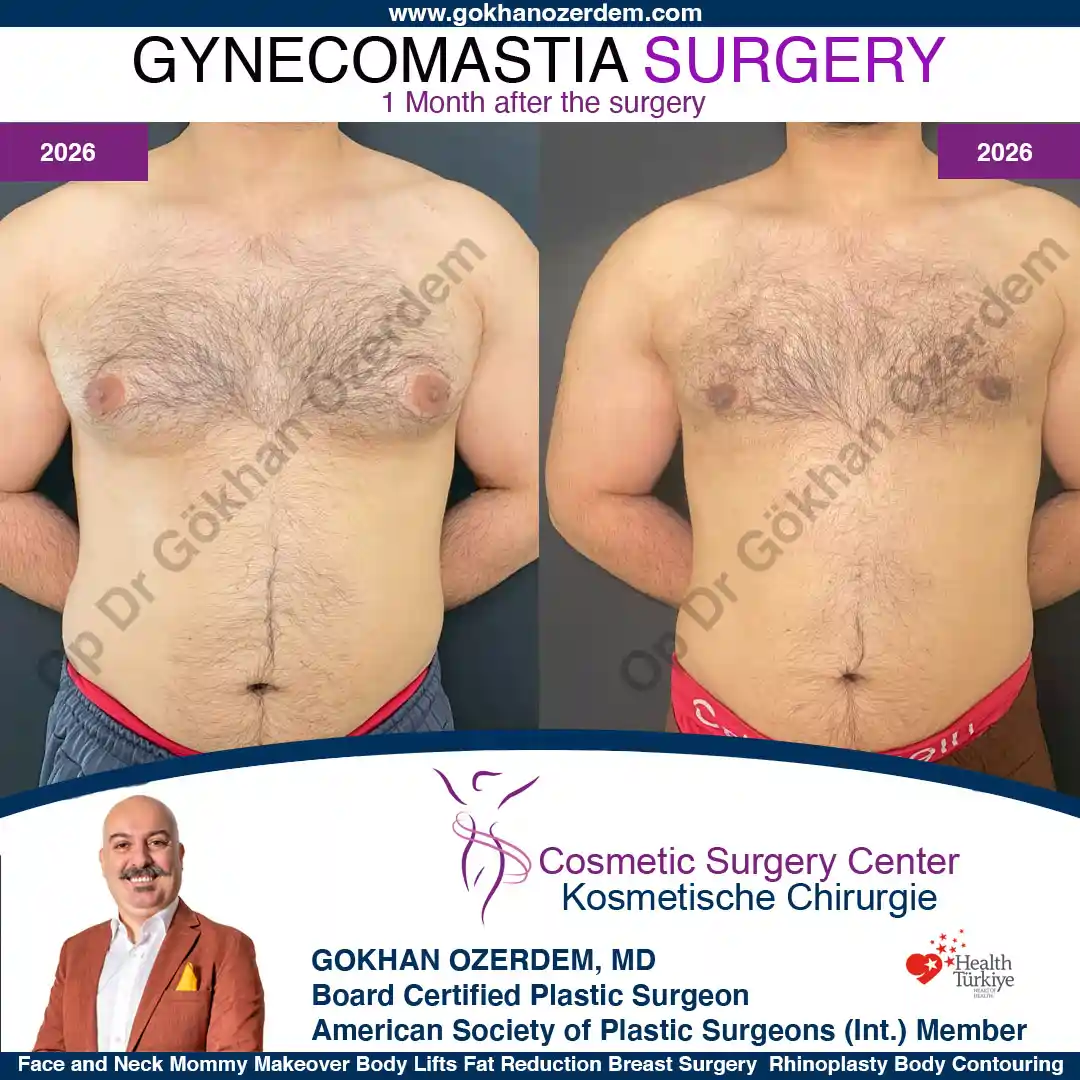
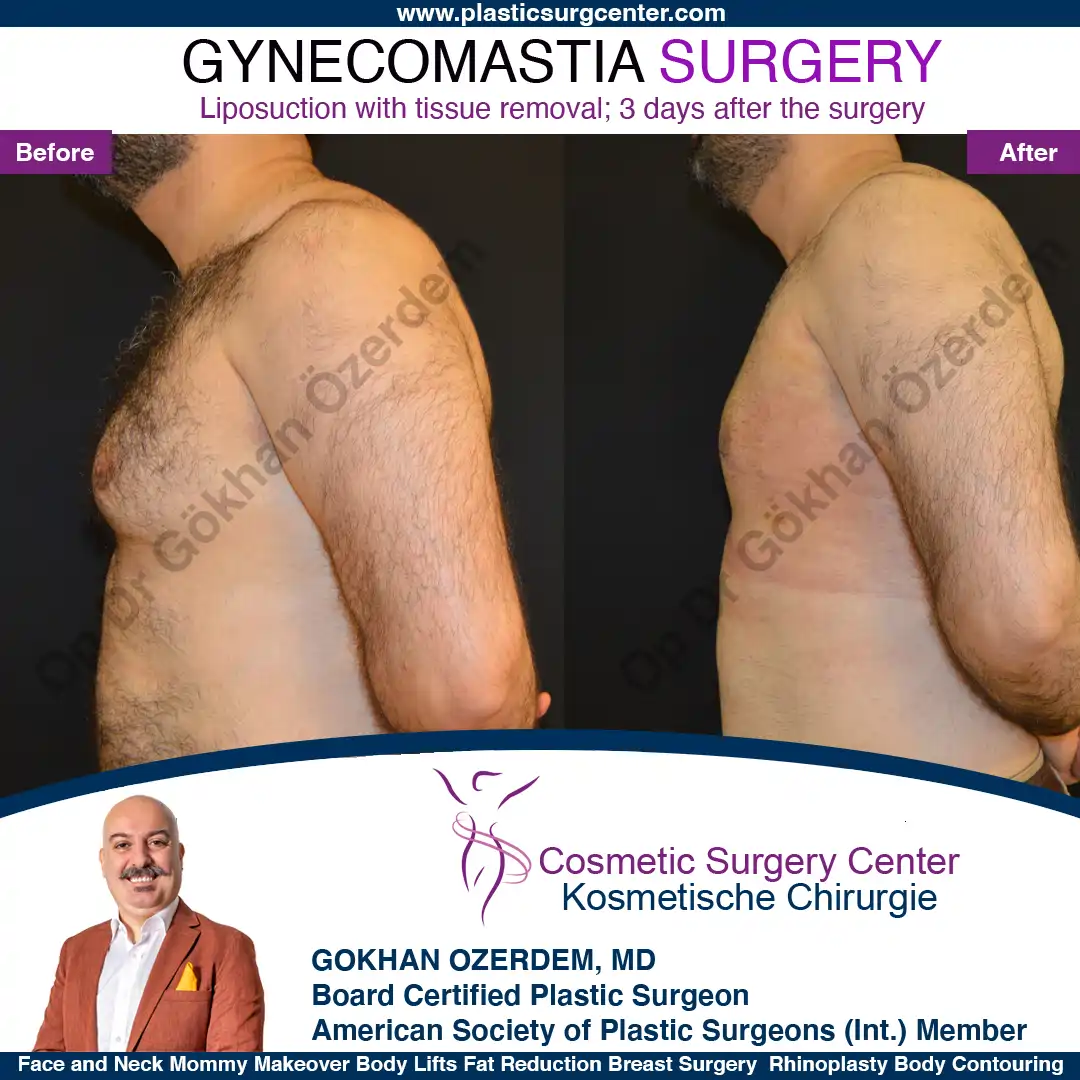
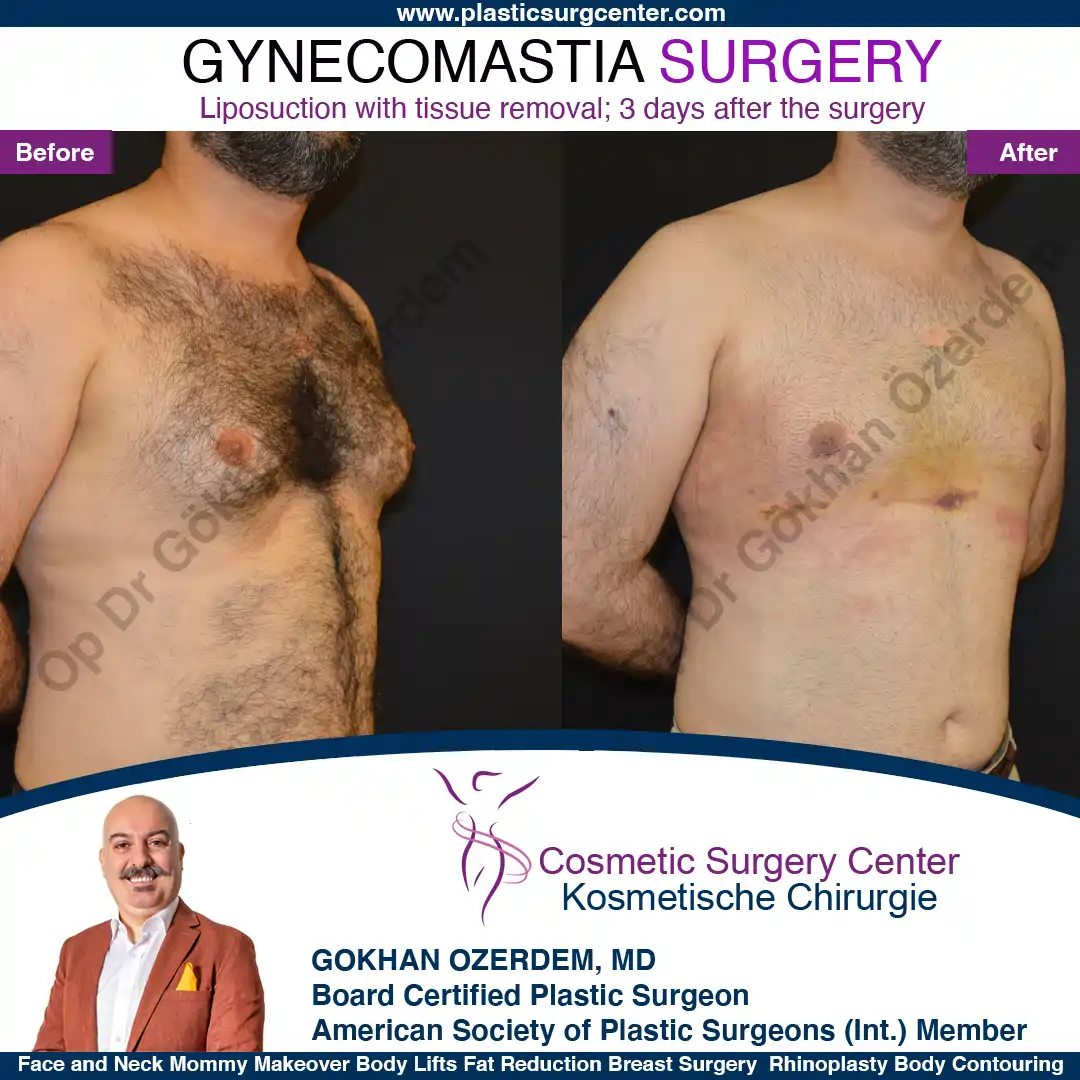
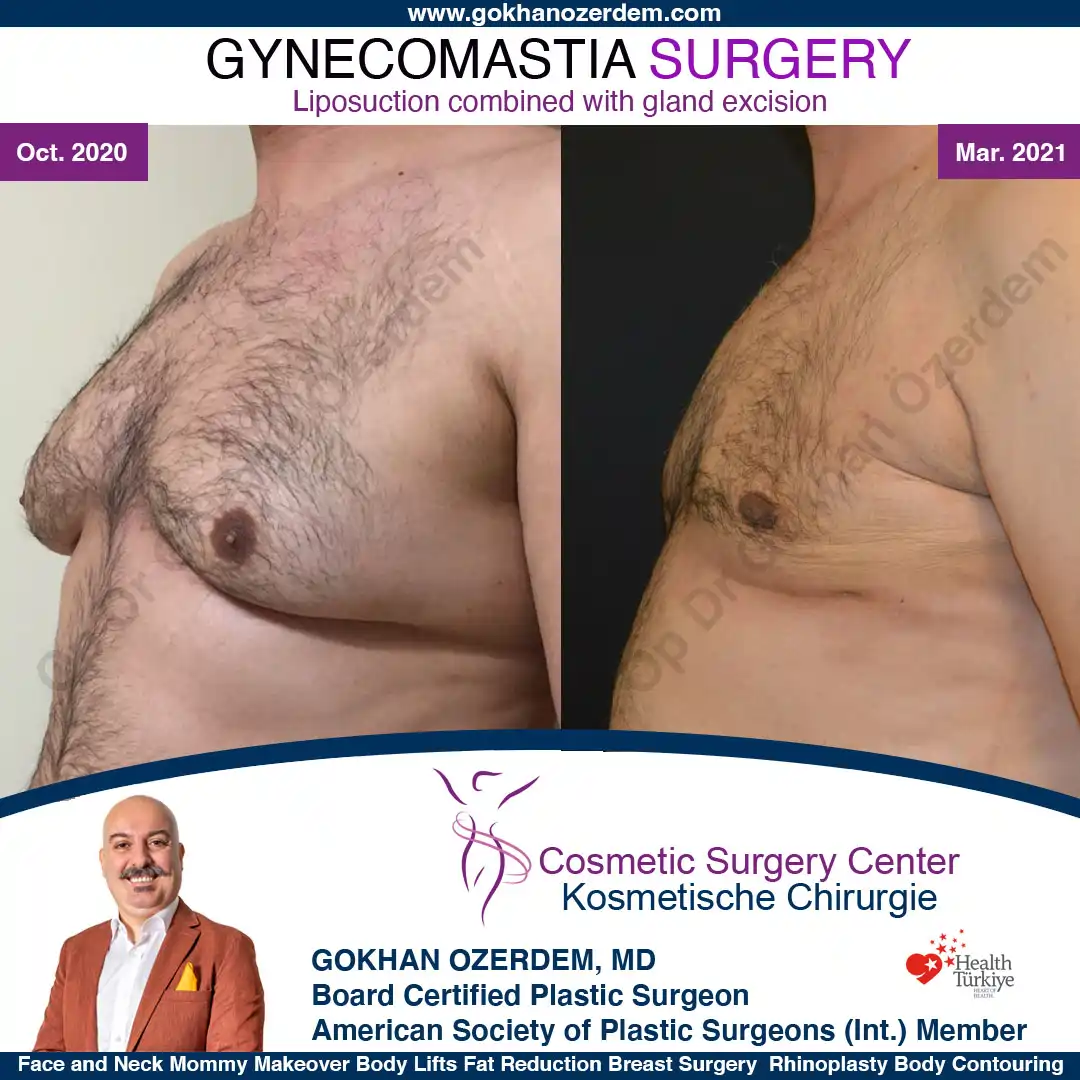
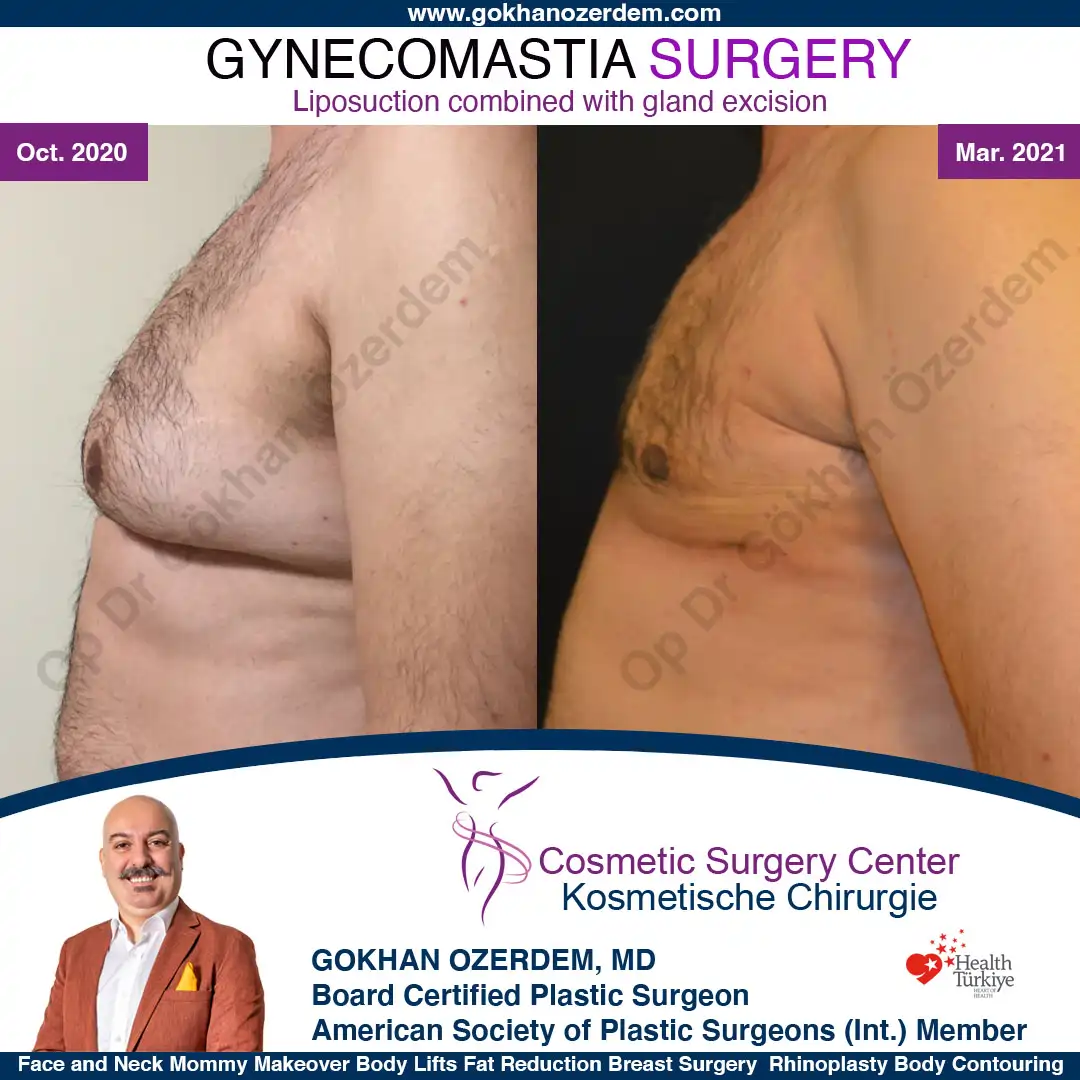
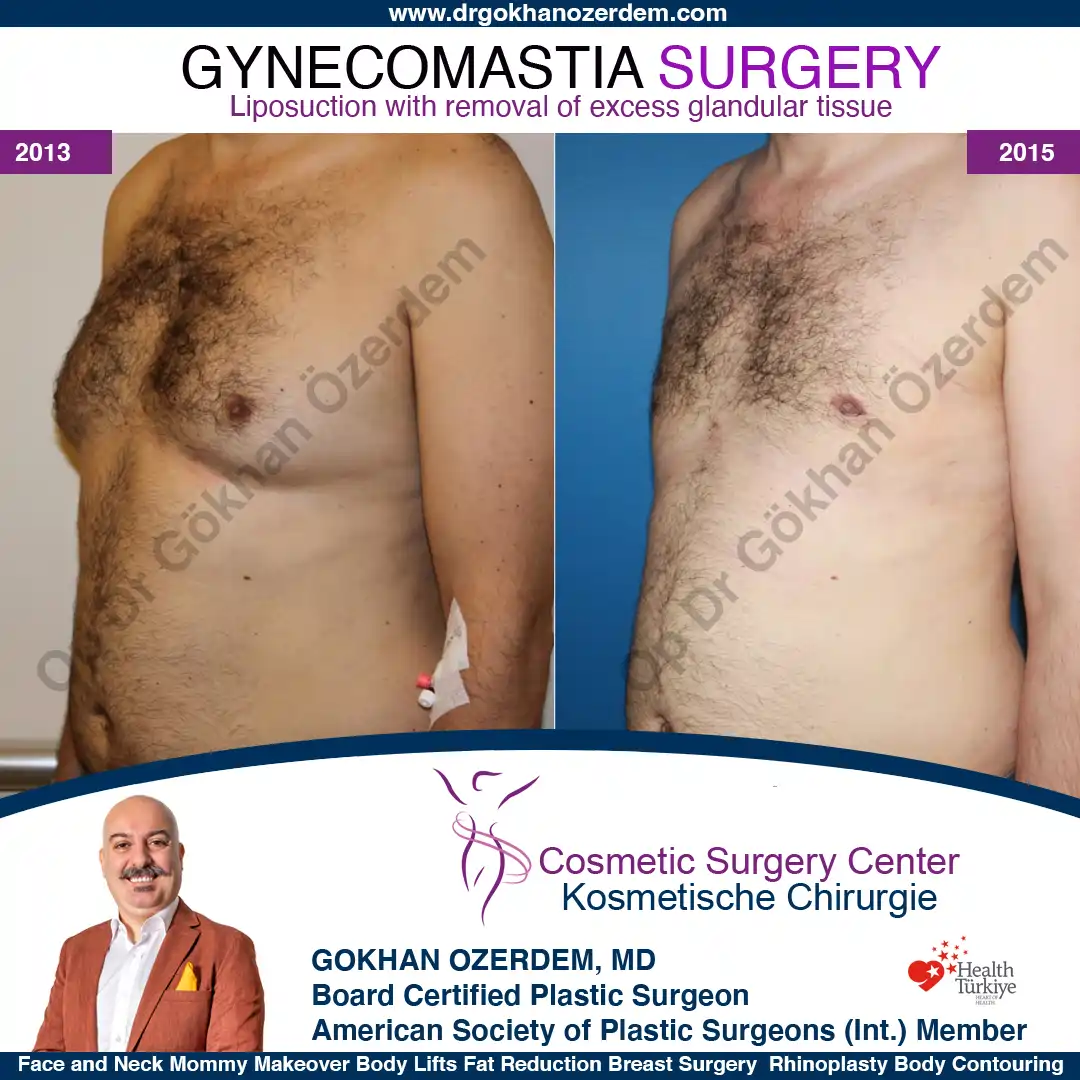
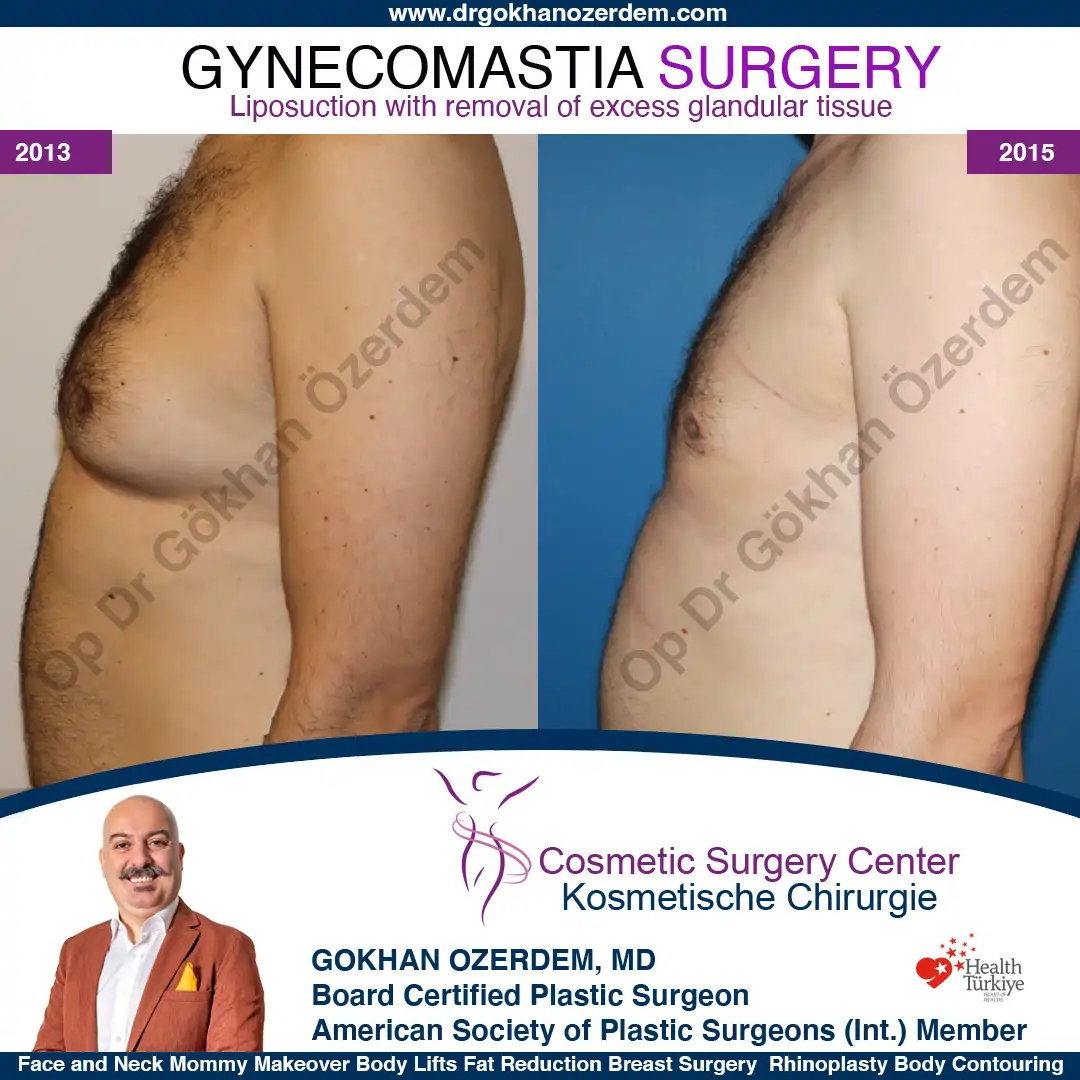
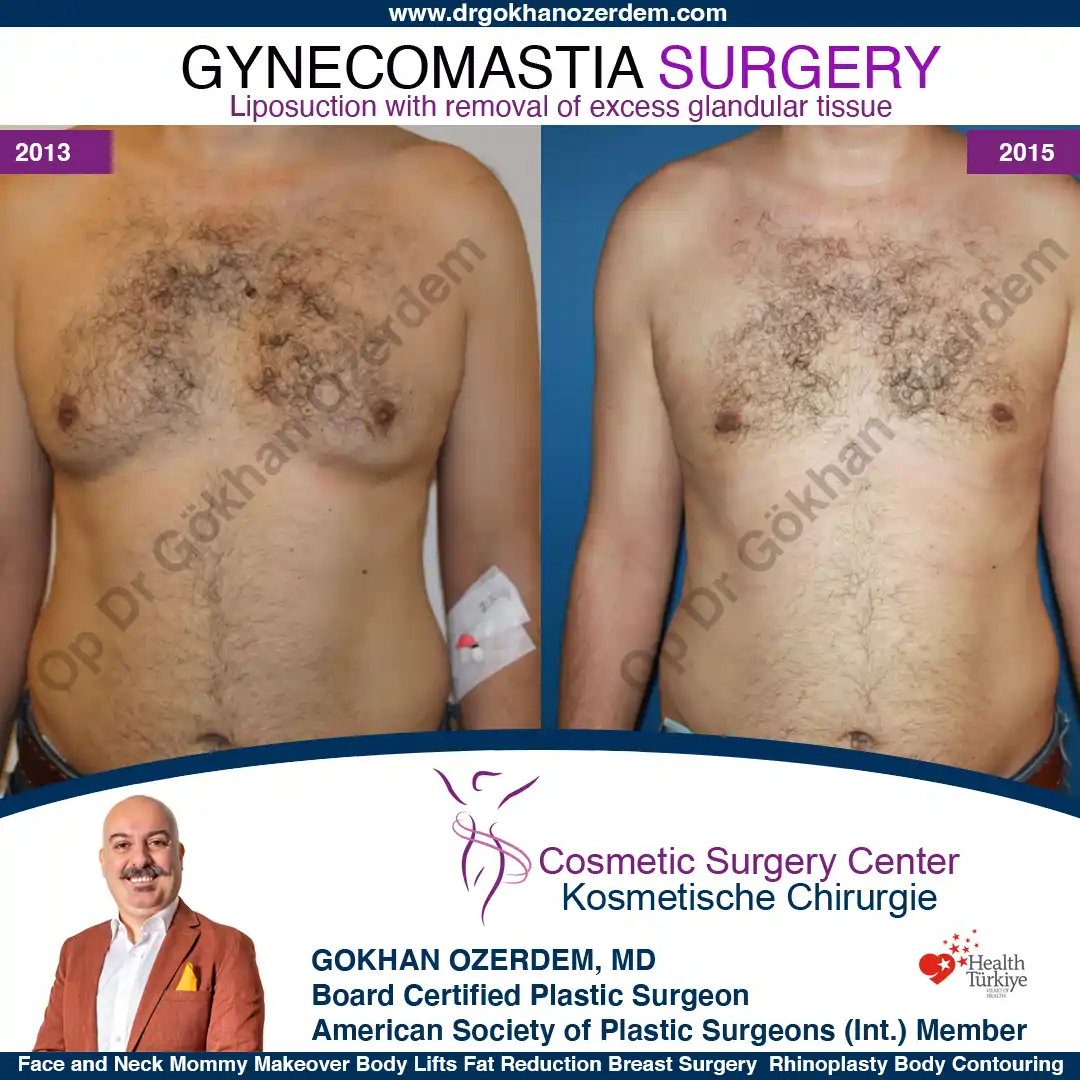
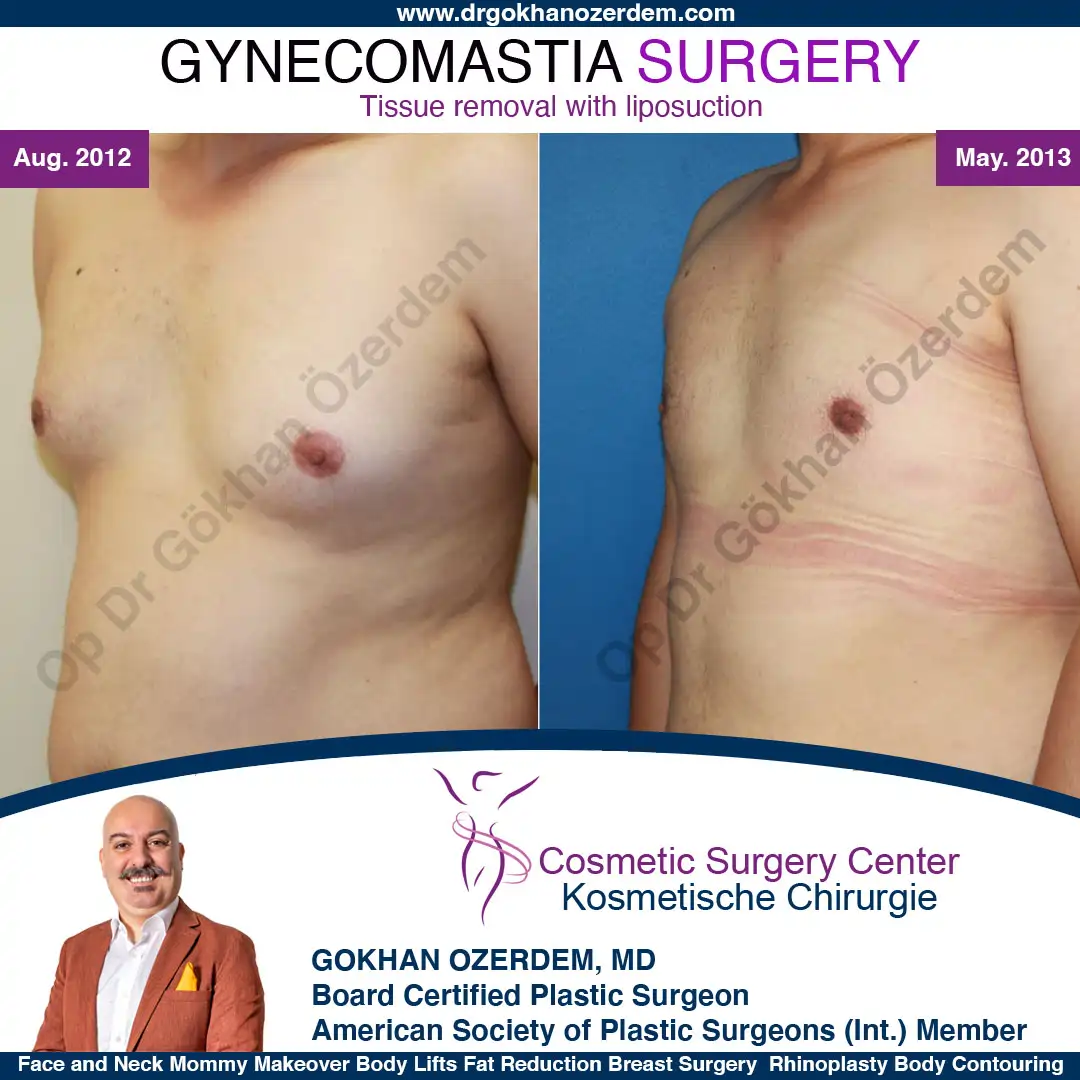
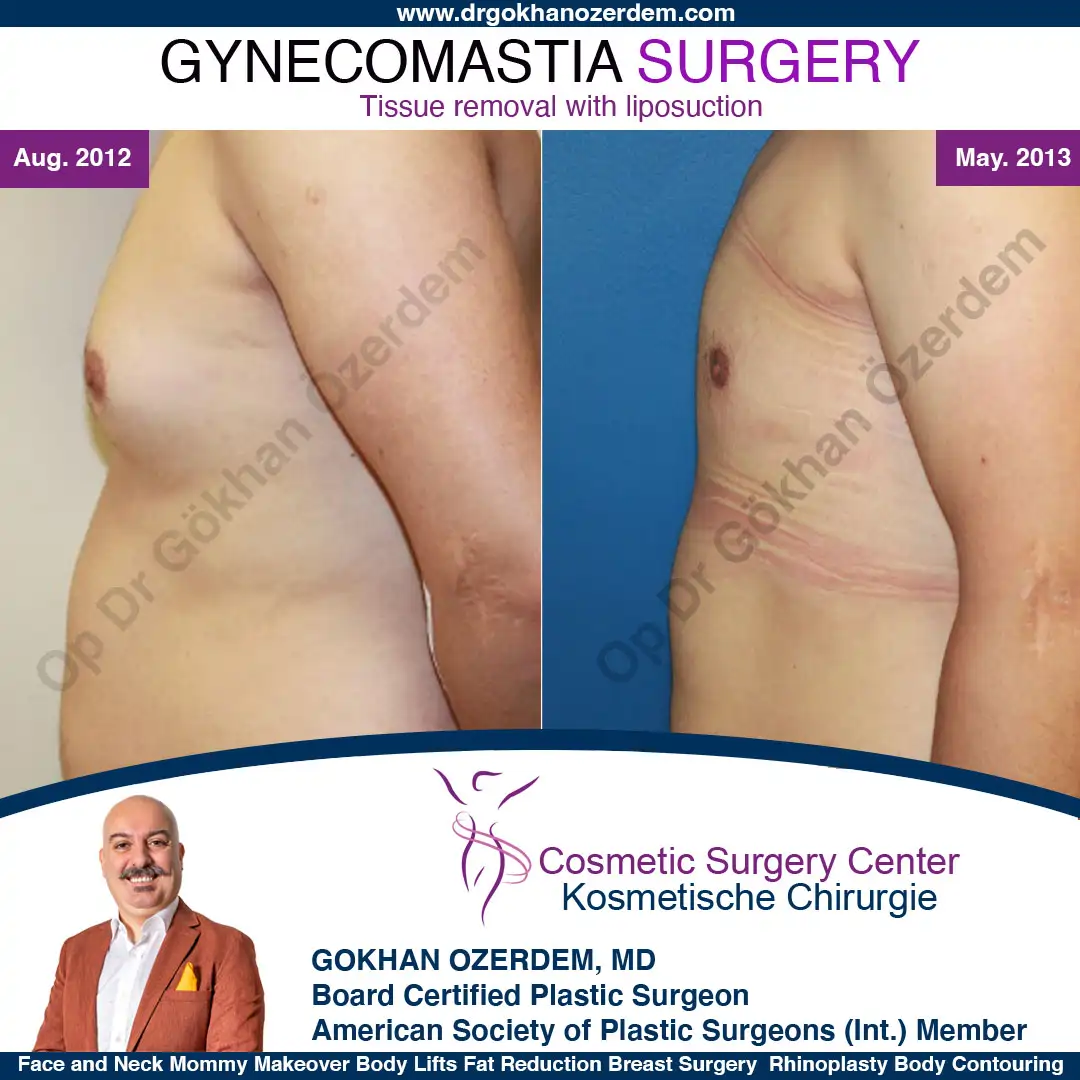
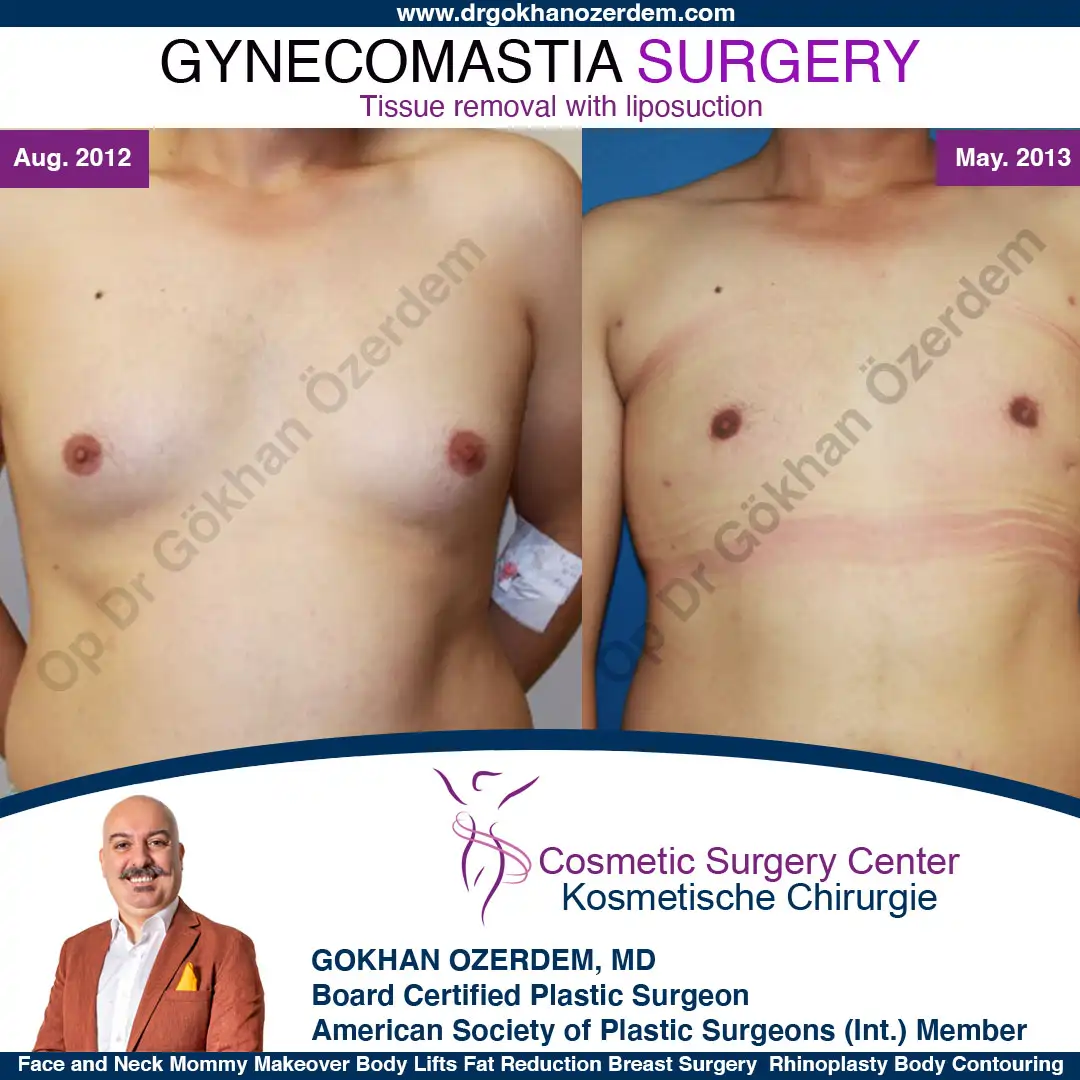
Gynecomastia Before and After
Male Breast Reduction Results
[GYNECOMASTIA BEFORE & AFTER GALLERY]
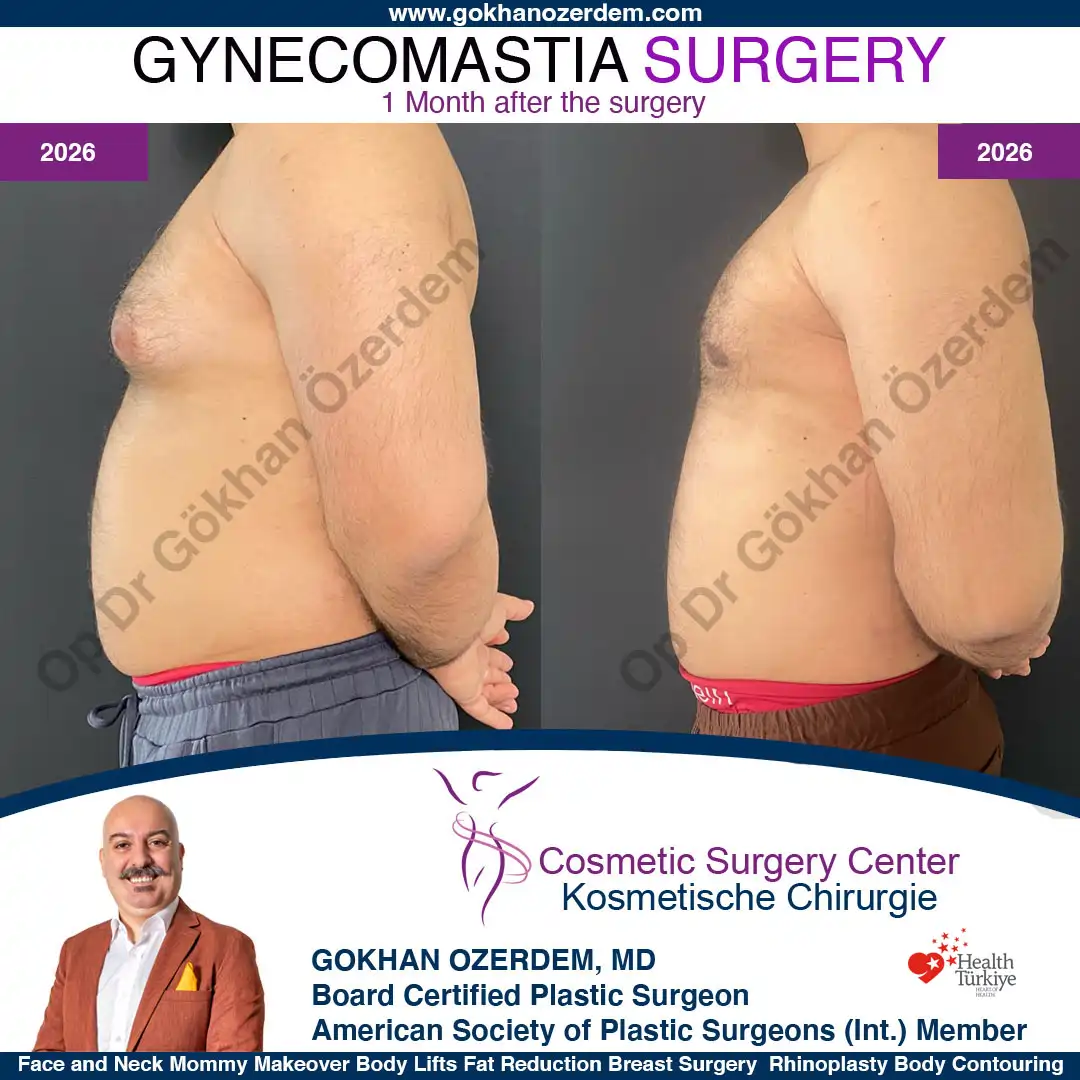
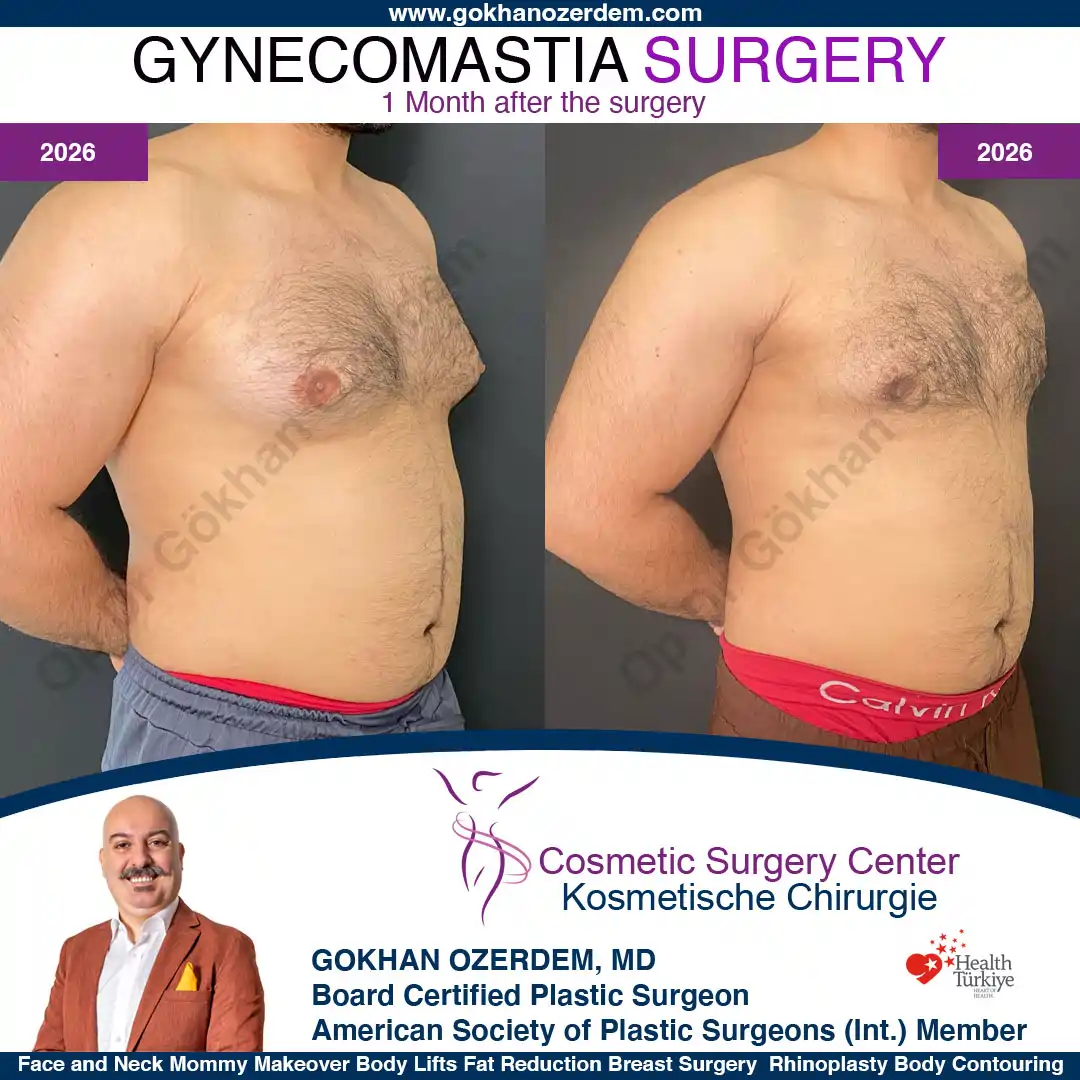
Before and after photographs can demonstrate changes in:
- Chest projection
- Nipple prominence
- Chest contour
- Skin excess
- Chest symmetry
- Overall male torso proportions
However, results vary according to the amount of glandular tissue, fat and loose skin.
A patient with mild gynecomastia cannot expect the same incision pattern or recovery as someone with severe enlargement and significant skin excess.
Previous patient photographs should be viewed as examples of individual results rather than guarantees.
Severe Gynecomastia and Loose Skin
When Is Skin Removal Necessary?
In patients with advanced gynecomastia, the skin may have been stretched for many years.
After removal of the underlying fat and glandular tissue, the skin may not contract sufficiently.
This can leave loose skin or an unnatural fold.
In these cases, I may recommend removing excess skin.
The operation may also require repositioning of the nipple–areola complex.
However, skin removal involves additional scars.
I explain this clearly before surgery.
For advanced gynecomastia, a better chest shape may require accepting a longer scar.
Gynecomastia After Major Weight Loss
Men who have lost a substantial amount of weight may have a combination of:
- Residual chest fat
- Glandular tissue
- Loose skin
- Low nipple position
- Loss of chest definition
These patients often require a different surgical approach from men with mild glandular enlargement.
Liposuction alone may not correct significant skin excess.
Depending on the anatomy, chest contouring may require direct tissue removal, skin excision and repositioning of the nipple–areola complex.
The operation is planned according to the remaining tissue and degree of skin laxity.
Puffy Nipples in Men
Some men have relatively normal chest contours but are concerned about nipples that appear puffy or prominent.
This appearance may result from glandular tissue beneath the areola.
However, nipple projection can also be influenced by fat distribution, skin characteristics and natural anatomy.
During consultation, I assess whether there is a surgically correctable glandular component.
When appropriate, carefully planned glandular excision may improve the contour.
The objective is to reduce unwanted prominence without creating a depressed nipple.
Can Exercise Eliminate Gynecomastia?
Exercise can improve general body composition and reduce body fat.
However, it does not reliably eliminate enlarged glandular breast tissue.
A man may be lean, physically active and muscular while still having gynecomastia.
In patients whose chest enlargement is predominantly caused by fat, weight reduction may improve the appearance.
But when firm glandular tissue is responsible, surgery may be necessary for a meaningful correction.
Can Weight Loss Cure Gynecomastia?
Weight loss may reduce the fatty component of an enlarged male chest.
However, glandular tissue may remain even after substantial weight loss.
This is why some men continue to have prominent nipples or breast enlargement despite achieving a healthy body weight.
The response to weight loss depends on the relative amounts of fat, glandular tissue and loose skin.
What Causes Gynecomastia?
Gynecomastia may develop for several reasons.
Potential contributing factors include:
- Hormonal changes during puberty
- Age-related hormonal changes
- Certain medications
- Anabolic steroid use
- Some medical conditions
- Changes in the balance between oestrogen and androgen activity
In some patients, no specific cause is identified.
Because gynecomastia can occasionally be associated with an underlying medical problem, appropriate evaluation is important.
Surgery should not replace investigation when the history or examination suggests a medical cause.
Gynecomastia During Puberty
Temporary breast enlargement is relatively common during puberty.
In many adolescents, it improves spontaneously as hormonal changes stabilise.
For this reason, surgery is not automatically the first treatment for a teenager with recently developed gynecomastia.
The duration of enlargement, symptoms, emotional impact and medical findings should be considered.
Persistent cases may require further assessment.
I prefer to evaluate younger patients carefully rather than recommend surgery solely because breast enlargement has appeared during puberty.
Gynecomastia in Adult Men
Adult men may develop gynecomastia at different stages of life.
Some have had the condition since adolescence.
Others notice enlargement later, sometimes associated with medication, hormonal changes or weight fluctuations.
In adults with persistent enlargement, surgery may be considered after appropriate assessment.
The choice of technique depends on whether the enlargement involves glandular tissue, fat, skin excess or a combination.
Can Gynecomastia Be a Sign of a Medical Condition?
Sometimes.
Although gynecomastia is often benign, certain hormonal disorders, medications and systemic conditions can contribute to male breast enlargement.
A new, rapidly developing or unexplained enlargement deserves appropriate medical assessment.
A hard, irregular or suspicious mass, particularly when accompanied by nipple discharge or skin changes, requires investigation.
Not every male breast lump should be assumed to be gynecomastia.
When necessary, I recommend further medical evaluation before considering aesthetic surgery.
Is Gynecomastia Surgery Painful?
Discomfort, tightness, swelling and tenderness are expected after surgery.
The degree of discomfort depends on the extent of liposuction, glandular excision and any skin removal.
Appropriate postoperative pain medication is provided.
Most patients find that discomfort gradually decreases during the early recovery period.
However, recovery varies between individuals.
Anaesthesia and Hospital
I perform gynecomastia surgery in an appropriately equipped hospital in Antalya, Turkey.
The choice of anaesthesia depends on the extent of surgery and the patient’s circumstances.
For operations involving combined liposuction and glandular excision, I commonly use general anaesthesia.
More extensive procedures, particularly those requiring skin removal, also require careful hospital-based planning.
The duration of surgery depends on the amount of tissue involved and the technique required.
Recovery After Gynecomastia Surgery
Swelling and bruising are expected during the early postoperative period.
The chest may initially feel firm, tender or uneven.
These changes generally improve gradually.
During recovery, patients should follow instructions regarding:
- Compression garments
- Wound care
- Showering
- Sleeping position
- Medication
- Arm movements
- Heavy lifting
- Exercise
- Smoking
- Scar care
The final contour should not be judged during the first days after surgery.
Compression Garments After Gynecomastia Surgery
A compression garment is commonly recommended after male breast reduction.
It can help support the operated area and manage postoperative swelling.
The type of garment and duration of use depend on the extent of surgery.
I provide individual instructions rather than recommend the same compression schedule for every patient.
When Can I Return to the Gym?
This is one of the most common questions from male patients.
Walking and light daily activity can generally begin earlier than strenuous exercise.
However, weight training and exercises involving the pectoral muscles place stress on the operated chest.
These activities should be avoided until healing has progressed sufficiently.
The appropriate timetable depends on whether surgery involved liposuction, glandular excision, skin removal or a combination.
Returning to heavy chest training too early may interfere with recovery.
When Can I Return to Work?
Return to work depends on the extent of surgery and the physical demands of the patient’s occupation.
Men with desk-based jobs may be able to return sooner than those who perform heavy lifting or strenuous physical work.
Patients should also consider whether they need to wear a compression garment during the early recovery period.
I provide individual advice based on postoperative progress.
When Will I See the Final Result?
The reduction in chest volume is visible relatively early.
However, swelling and tissue firmness can temporarily affect the contour.
During the following weeks and months:
- Swelling decreases
- The chest becomes softer
- Skin gradually adapts
- Residual firmness improves
- Scars begin to mature
The final chest contour may take several months to become established.
Patients with extensive skin removal may require a longer period for scar maturation.
Can Gynecomastia Return After Surgery?
Gynecomastia surgery is intended to provide a long-lasting improvement.
However, recurrence or renewed enlargement is possible.
This may occur if:
- An underlying hormonal problem persists
- Certain medications contribute to renewed growth
- Anabolic steroids are used
- Significant weight gain occurs
- Residual glandular tissue enlarges
Removing tissue does not prevent every possible future cause of breast enlargement.
Appropriate medical assessment and maintaining a stable weight can help reduce avoidable risks.
Gynecomastia Surgery and Chest Masculinity
The objective of male breast reduction is not simply to make the chest as flat as possible.
A natural male chest has its own contours.
The relationship between the pectoral muscle, nipple–areola complex and surrounding soft tissues should be preserved.
Excessive tissue removal may create an unnatural depression.
Insufficient removal may leave unwanted fullness.
My aim is to achieve an appropriate contour while respecting the patient’s existing chest anatomy.
Risks and Limitations of Gynecomastia Surgery
Male breast reduction is a surgical procedure and carries potential risks.
These may include:
- Bleeding
- Infection
- Haematoma
- Seroma
- Delayed wound healing
- Unfavourable scarring
- Chest asymmetry
- Residual glandular tissue
- Persistent fullness
- Contour irregularities
- Crater deformity
- Changes in nipple sensation
- Skin irregularities
- Partial or complete nipple–areola tissue loss in rare extensive cases
- Recurrence
- Need for revision surgery
- Anaesthetic complications
- Blood-clot-related complications
The relevant risks depend on the patient’s anatomy, health and planned procedure.
These are discussed before surgery.
Gynecomastia Surgery in Turkey for International Patients
Travelling to Antalya for Male Breast Reduction
International patients considering gynecomastia surgery can begin with a preliminary assessment before travelling to Turkey.
My team may request:
- Medical history
- Current medication
- Duration of breast enlargement
- Previous hormonal investigations, if any
- History of anabolic steroid use
- Previous chest surgery
- Weight history
- Photographs for preliminary assessment
These details help determine whether further medical evaluation may be necessary before surgery.
Photographs can assist with preliminary planning, but they do not replace physical examination.
The final surgical plan is confirmed after I examine the chest personally in Antalya.
How Long Should I Stay in Antalya After Gynecomastia Surgery?
The recommended stay depends on the extent of surgery and early recovery.
For international patients, I generally advise planning approximately 7–10 days in Antalya when practical, particularly when combined liposuction and glandular excision are performed.
Patients undergoing more extensive skin removal may require additional consideration.
The final travel schedule depends on wound healing and the necessary postoperative checks.
I do not recommend choosing a return flight simply because it is the earliest available option.
Why Choose Dr Gökhan Özerdem for Gynecomastia Surgery?
Male breast reduction requires careful distinction between fat, glandular tissue and loose skin.
The surgeon must decide:
- Whether true gynecomastia is present
- Whether further medical assessment is necessary
- How much fat should be removed
- Whether glandular excision is required
- How much tissue should remain beneath the nipple
- Whether the skin will contract adequately
- Whether skin removal is necessary
- Where scars should be positioned
- How to preserve a natural male chest contour
With more than 25 years of surgical experience, I frequently use liposuction combined with glandular excision when both fatty and glandular components are present.
For patients with advanced enlargement and significant skin laxity, I explain when skin removal is necessary and why this involves additional scars.
I do not consider a very flat chest with an obvious depression beneath the nipple to be a successful result.
My objective is to reduce unwanted breast prominence while maintaining a natural relationship between the nipple, chest muscle and surrounding tissues.
Frequently Asked Questions About Gynecomastia
Gynecomastia is the enlargement of glandular breast tissue in males. It may affect one or both sides of the chest and can occur at different ages.
True gynecomastia involves glandular breast tissue, while pseudogynecomastia mainly involves fatty tissue. Many men have a combination of both.
Exercise can reduce body fat but does not reliably eliminate enlarged glandular breast tissue.
Weight loss may improve the fatty component, but glandular tissue may remain. The result depends on the underlying anatomy.
Yes. I frequently use liposuction to reduce the fatty component and improve chest contour.
Not always. Firm glandular tissue may require direct excision. In my practice, I often combine liposuction with glandular removal.
In many patients, the incision can be positioned along part of the areolar border, helping conceal the scar.
All surgical incisions create scars. In mild and moderate cases, scars can often be relatively small and discreet. Severe cases requiring skin removal may involve longer scars.
A crater deformity is an unnatural depression beneath the nipple–areola complex that can occur when excessive tissue is removed.
The objective is a natural male chest contour rather than removing all tissue. Excessive flattening can produce an unnatural appearance.
If the prominence is caused by surgically correctable glandular tissue, carefully planned excision may improve the appearance.
Skin removal may be necessary when significant skin excess remains, particularly in severe gynecomastia or after major weight loss.
Persistent gynecomastia in adolescents may require assessment, but many cases arising during puberty improve spontaneously. Surgery should not be the automatic first option.
Yes. Certain medications and substances, including anabolic steroids, can contribute to gynecomastia. Relevant medical history should be reviewed before surgery.
Not every patient requires the same investigations. Hormonal or other medical tests may be recommended when the history or examination suggests an underlying cause.
Discomfort, tenderness and tightness are expected during early recovery. Appropriate pain management is provided.
A compression garment is commonly recommended after surgery. The duration depends on the procedure and recovery.
Return to exercise should be gradual. Heavy chest training and strenuous upper-body activity require a longer restriction than walking or light daily activity.
This depends on the extent of surgery and the physical demands of your work. Desk-based work may be resumed earlier than strenuous physical work.
Recurrence is possible, particularly if hormonal factors, medication use, anabolic steroids or significant weight changes contribute to renewed enlargement.
Temporary changes in nipple sensation can occur. Permanent changes are also possible, although the risk varies according to the procedure.
Yes. However, swimming, strenuous exercise and strong sun exposure to healing scars should be avoided during the appropriate recovery period.
For many international patients, I recommend approximately 4–5 days, although the exact period depends on the operation and early recovery.
Yes. Follow-up communication continues after you leave Turkey. Photographs may be requested, and local medical assessment may be recommended if an in-person examination becomes necessary.
Considering Gynecomastia Surgery in Antalya, Turkey?
If you are concerned about an enlarged male chest, the first question should not be:
‘Can the fat simply be removed?’
The more useful questions are:
Is the enlargement caused by glandular tissue, fat or both? Is the skin sufficiently elastic? Will glandular excision be required? And what chest contour can realistically be achieved?
An initial assessment can help clarify these questions before you make your travel arrangements.
Dr Gökhan Özerdem
Specialist in Aesthetic, Plastic and Reconstructive Surgery
Antalya, Turkey
Contact Our International Patient Team
Request a Preliminary Gynecomastia Assessment
Face: – Rhinoplasty – Eyelid Surgery – Forehead and Brow Lift – Ear Surgery –
Breast: – Breast Augmentation – Breast Lift – Breast Reduction – Gynecomastia –
Body: – Tummy Tuck – Mini Tummy Tuck – Liposuction – Arm Lift – Thigh Lift – Body Contouring – Mommy Makeover –